Exploring the Benefits of Transcendental Dependent Origination
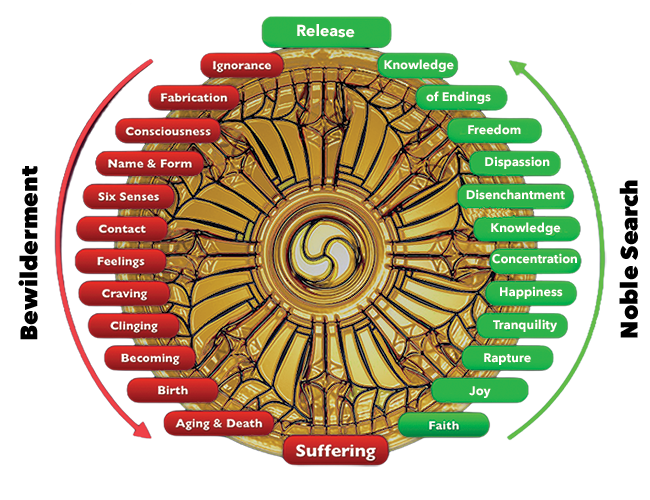
.On the left side are the links of Dependent Origination and on the right side are the links of Transcendental Dependent Origination (also referred to as Dependent Arising).
Buddha said the result of suffering (attachment to pleasant, resistant to unpleasant, ignoring neutral) is staying in bewilderment or taking up a noble search.
Characteristics of Transcendental Dependent Arising
Practicing with Transcendental Dependent Arising
Building a Foundation for Liberation
We often think of the foundations we build as strong cement-like structures. In Transcendental Dependent Origination (TDO), however, the foundation is built on the quiet subtlety of faith, joy and rapture, a kind of uplifted attention. We tend to think the presence of dukkha means something’s wrong, challenging or bad. We think of faith, joy and rapture as good things. But dukkha, faith, joy, and rapture are intertwined in the same moment in time. Luang Por Chah, a well-regarded Thai Forest Monk, said that “peace is within oneself to be found in the same place as agitation and suffering. It is not found in a forest or on a hilltop, nor is it given by a teacher. Where you experience suffering, you can also find freedom from suffering. Trying to run away from suffering is actually to run toward it.” This year we will be using TDO as the place where we build our foundation through practice. It is a foundation based in cultivating an uplifted attention (interest or curiosity) towards something or some moment rather than the sense of lacking or problem.
Developing Inward Stability
What we are developing when we practice with TDO is an internal discipline that brings with it an internal resilience and a kind of internal intimacy. The resilience enables us to stand within the present moment without having to change it. The intimacy allows us to come face-to-face with the limitations of our opinions, assumptions, beliefs, and thoughts, judgements and comparisons about things. Here we develop the second set of groupings – tranquility, happiness (sukkha) and concentration come into play. This is about learning to steady the mind. Some of the most challenging things in our lives have nothing to do with what’s going on outside of us. Sometimes our fixes work, but they are temporary and unreliable. In order to see in a new way, we need to steady our minds. Steady our attention. And not keep running after narratives and stories of the mind. When the mind is unified and stable, we can let the difficulty be and come to understand the appropriate response. This year, let’s see if we can bring interest or curiosity to whatever bothers us. Can we cultivate a radical agreement with ourselves to first accept the truth of the moment and respond from that, rather than simply reacting to everything we don’t like?
Understanding The Conditionality Of Liberation
TDO is a mirror image of dependent origination. Dependent origination flows from ignorance to dukkha (suffering) and transcendental dependent arising flows from dukkha to the cessation of suffering (liberation). Often transcending is commonly thought of as a kind of leaving or getting out of the body to some other worldly state. To transcend is defined as rising above or going beyond the limits of something; to triumph over the negative or restrictive aspect of something; to overcome. This is what we are learning to do with dukkha. We do this through understanding the nature of dukkha rather than running away from it or pushing it away. In effect, this practice is about transcending inward rather than out. Transcending is like descending into our own present moment, getting closer and closer and more intimate with what’s actually happening. We gradually learn that we don’t need the outer conditions to change. We don’t need to bear down and take it until we’ve squashed the life out of it. We don’t have to fight with our difficulties until we get it right. This is where disenchantment and dispassion come into play. We begin to grow weary of our old habits, patterns and conditioning. This year we will look at the patterns and conditions that come together in what we call life. It means we need to stop taking everything so personal. See experience as habits, patterns, and conditioning. Are we willing to stay with experience until we can learn how the moment has come to be?
Cultivating Clear Seeing
Cultivating clear seeing is about cultivating the last of the 12 links in TDO – knowledge and vision of things as they are or how they have come to be. It begins with the uplift of faith, joy and rapture. That uplift is what helps us steady the mind with tranquility, happiness and concentration. Gradually, we begin to see our habit patterns over and over. Each time, we try to let go of any unskillful behavior and sustain any skillful behavior. It takes sincerity and persistence. We have to see the truth of our conditionality in pristine clarity before we will be willing to let it go. Once we have this knowledge and vision of things as they are, we’re not seeing the truth of a miserable world, we’re seeing the truth of our habit pattern and the nature of samsara. We’re seeing the truth of what these habit patterns do. This is why disenchantment and dispassion are so important even in lay practice. This year, let’s open up to the truth of our habits and see if we can begin to cultivate alternative ways of responding.
Experiencing Genuine Release
To actually experience genuine release the mind needs to free itself. We cannot do it ourselves. The mind will never be free if it’s tethered to its old habits and wants. Our minds tend to think that doubling down on old habits is the way to freedom. Mostly because we believe, trust or have faith in the old habits. The more you become disenchanted and dispassionate about habits the more you will want to find another way to respond. Buddha said the result of dukkha is bewilderment or noble search. This noble search arises out of our true values and intentions. The more you will act from your true intentions, rather than habit, the freer you feel. When we are released from the grip of habit, it feels like freedom. It feels like we can be ourselves. We are no longer trapped by the remorse of my past or my fears about the future. This year we want to cultivate a practice that will allow the mind to free itself – even for one moment.